No. 04Culture7 min read
Tourist vs. Purist
Virgil Abloh's organizing principle: make things for the person who knows nothing and the person who knows everything, at the same time.
·
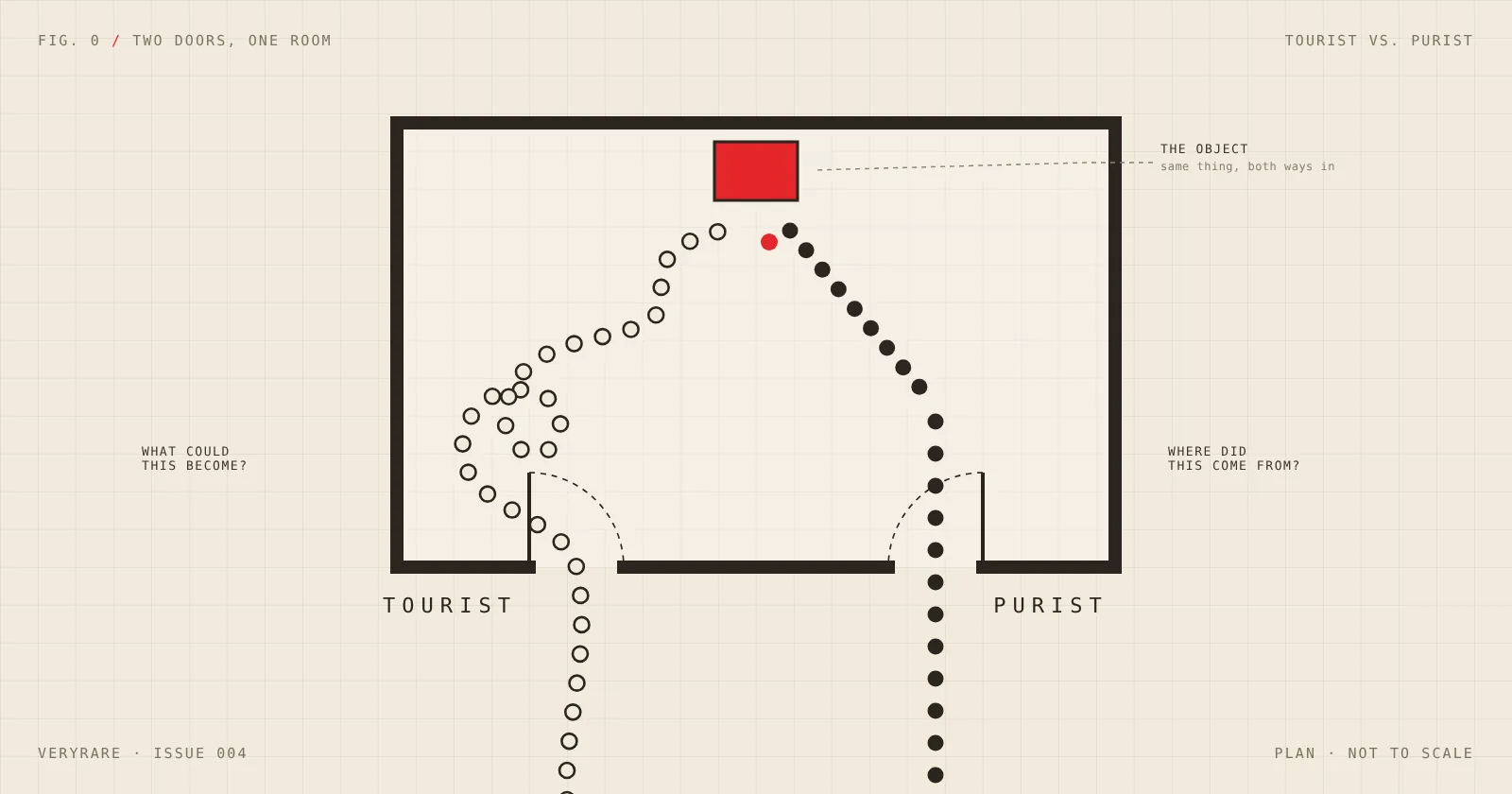
Put two people in front of the same thing. A sneaker, a painting, a jacket. One of them knows everything about it: the references, how it was made, who did it first. The other knows none of that. They just stop, look and feel something.
Which one saw it right?
Virgil Abloh thought that was the wrong question. In case the name only rings a bell: Abloh was born in Rockford, Illinois, in 1980 to Ghanaian immigrant parents. He trained as a civil engineer, then as an architect, started the label Off-White, and in 2018 became the artistic director of Louis Vuitton’s menswear, the first African American to hold the job. He died in 2021, at 41.
He had names for the two people in front of that sneaker: the tourist and the purist. A lot of his work was an attempt to make one object that pays off for both of them.
Tourist or purist?
He called it his organizing principle. The tourist, as he put it to Vogue in 2021, is eager to learn, the visitor in Paris who wants to see the Eiffel Tower. The purist is “the person who knows everything about everything.” In a film made for his first museum show two years earlier, he described what all that knowledge buys you: “A purist can find value in meaning based on an underlying premise.”
That show, Figures of Speech, opened at the Museum of Contemporary Art Chicago in June 2019, and it asked you the question before you saw a single object. “Tourist or purist?” was up at the entrance. AMO, the research studio of Rem Koolhaas’s firm OMA, designed the rooms with those two kinds of visitor in mind.
In the catalog, the curator Michael Darling described Abloh running both modes at once: a fan’s uncomplicated pleasure in finding new things, and the critical eye of someone who works inside the field. Neither one is the dumb one. They’re asking different questions. The tourist wants to know what this could become. The purist wants to know where it came from.
The closed-door system
Getting good at something has a catch. The more you know, the better you judge, and the better you judge, the faster you can dismiss whatever doesn’t fit. Knowledge protects you from bad work. It can also protect you from new work.
Abloh talked about this in the same catalog, in a conversation with Koolhaas and Samir Bantal, who runs AMO. Tourists may not know much, he said, but that’s not what decides whether they succeed. He’d built his work to widen people’s thinking rather than reassure the ones whose minds were made up, which kept it in the middle. Then he said the line I keep coming back to: “If I swing toward purist, I’m reinforcing the closed-door system.” When the show reached Boston in 2021, WBUR described Abloh’s purist as someone whose knowledge turns into high walls around art.
Koolhaas liked the opposition and pushed on it. A smart purist, in his view, keeps landing in places where he’s the beginner again, and a smart tourist wants at least the purist’s knowledge. What he liked was the back-and-forth. Here’s a toy version of that door.
How much should the door ask for?
Each dot is a visitor walking up to a gallery. The more filled in a dot is, the more it already knows. Set what the door demands and watch who ends up inside.
Push the bar up and the room gets quiet and sure of itself. Drop it to nothing and the room fills up but has a short memory. Now turn on learning. A high bar stops being a wall and turns into a waiting room, and the question becomes how many people give up in it.
Three percent
In October 2017 Abloh lectured at Harvard’s Graduate School of Design and flashed what he called cheat codes on bright red slides. He also laid out a seven-point manifesto, “Personal Design Language.” Speaking to the tourist and the purist at the same time was on it. So was the 3 percent approach: take something that already exists and change it by about 3 percent.
That’s how one object talks to both people. The 97 percent is the welcome, because the tourist recognizes it right away. The 3 percent is the argument, and the purist reads it. Abloh often pointed to Marcel Duchamp, who in 1917 signed a store-bought urinal “R. Mutt 1917” and submitted it to an art exhibition. “Duchamp is my lawyer,” Abloh told 032c. In the same interview he said that writing “woman” on the back of a men’s sweatshirt makes it art. Try it on a hoodie.
How much can you change before you lose someone?
Start with an object everybody already owns. Drag the slider to change more of it, and watch who's still in the conversation.
IKEA let him run the same trick at mass scale. His MARKERAD collection reached US stores on November 1, 2019: a rug drawn like a giant IKEA receipt, a green rug that says “WET GRASS,” the store’s blue shopping bag recolored and labeled “SCULPTURE,” a white clock marked “TEMPORARY.” Darling saw the pieces doing two jobs, baiting design obsessives while keeping the store’s promise of good design for everybody. The joke lands if you’ve never heard of Duchamp. It gets better if you have.
Dirt v soil
One of Abloh’s red slides is nothing but a list of seven pairs, tourist v purist among them. I haven’t found him explaining the rest, so the readings in this figure are mine. Here’s the left side of each pair. Guess the right side, then flip it.
Guess the other half
Seven pairs from one of Abloh's red slides. The left side is showing. Guess the right side, then tap the line to flip it.
The same thing happens all the way down the list. The material barely changes. The frame does. Context doesn’t just explain what you’re looking at. Sometimes it changes what the thing is.
Nobody stays a tourist
A tourist who keeps looking turns into someone who knows. They learn why a painting matters, why a garment takes months to make, why a scene started in one particular place. Then something strange happens. The person who once broke a rule starts defending it, because now they have taste, credentials and something to lose.
Abloh lived on both sides of that line. He had no formal fashion training (his mother, a seamstress, taught him to sew), and he ended up running menswear at a house founded in 1854.
So the two words describe positions, not personalities. You can be a purist about sneakers and a tourist at a jazz show in the same week. Abloh described the twenty years of work in his show as a constant search for ways to go from consumer to provider, moving back and forth between the two. Map yours.
Where are you a tourist?
Tap a field once if you're a tourist there, twice if you're a purist, a third time to clear it. Skip the ones that aren't your world.
nothing yet
Hold it open.nothing yet
Walk in anyway.The VERYRARE take: learn like a purist, make like a tourist
This one is personal, because it’s part of how I think about making VERYRARE. I love the worlds with rules: fashion, fine art, Japanese visual culture, craft, cinema. I love digging into a reference until it reveals a history, a technique, a reason for existing. But I never want that knowledge to become a permission slip someone else has to sign before I can create.
Some of the things that excite me most don’t naturally belong together. An Old Master painting and a contemporary silhouette. The visual drama of anime and the density of a woven tapestry. A historical motif reappearing on a piece of clothing that somebody will actually wear in the street. The collisions may feel obvious to a tourist and almost sacrilegious to a purist. That’s often where I start paying attention.
There’s a responsibility attached to those choices. You can’t just sample a culture, slap it onto fabric and call the result depth. The image has an origin. The craft has a language. The material has its own demands. A jacquard is not merely a print: its meaning also lives in the structure of the weave. The deeper I go into making, the more I respect the purist’s insistence that details matter.
But there’s another responsibility too: not to design only for people who already know. I don’t think someone should need a dissertation on a reference to connect with a garment. If it moves them before they know the story, that reaction is valid. If discovering the story later makes the piece feel different, even better. The two experiences should feed each other.
So I try to give every piece more than one level of entry. Let the first encounter be visceral. Let the second reveal intention. Let the third uncover something the wearer didn’t know was there.
One piece, three ways in
Our Saint Jerome/writing knit starts from a Caravaggio. Open the doors in order.
No names needed. A pool of light, a slab of red, a skull, someone bent over his work. It lands before you know a thing about it.
Caravaggio painted Saint Jerome, the scholar behind the Latin Bible later called the Vulgate, from the Latin for "common version." Translation is a purist's craft done for everyone else.
Now look at the two heads. Caravaggio builds the picture on the saint's bald head and the skull across the table, with the writing hand in between. Our knit adds one more layer: Isaiah 41:10, reworked into "I am VERYRARE."
Some of our product pages say “if you know you know.” That’s the purist talking, and he’s not wrong. But I’d add a line for everybody else:
If you don’t know yet, come in anyway.
I want to keep learning like a purist and making like a tourist. To be serious about the craft without becoming imprisoned by the canon. To respect the people who built the walls, and still ask whether those walls need a door.
Because culture doesn’t belong only to the people who understand it best. It belongs, too, to the people who care enough to walk in.
Don’t erase the origin. Don’t close the door.
— [ARTWEAR c/o Raf Reyes]
Notes & further reading
- Museum of Contemporary Art Chicago, “Virgil Abloh”, video and transcript made for Virgil Abloh: “Figures of Speech”, June 10 to September 22, 2019.
- Vogue, review of the Louis Vuitton Fall 2021 menswear show, January 2021.
- Michael Darling (ed.), Virgil Abloh: “Figures of Speech”, MCA Chicago and Prestel, 2019: Darling’s essay, and Abloh in conversation with Rem Koolhaas and Samir Bantal.
- On the show: The Architect’s Newspaper and Dezeen, 2019; WBUR, 2021. Metal quotes Abloh’s own statement on it.
- Harvard Gazette, “Harvard welcomes Virgil Abloh for GSD lecture”, November 2017; The Heights on the red slides and the 3 percent approach. The talk was published as Insert Complicated Title Here (Harvard GSD and Sternberg Press, 2018).
- Thom Bettridge, “Duchamp is my lawyer”, 032c. Tate, Marcel Duchamp, Fountain.
- Dezeen, “Virgil Abloh reveals full IKEA collection ahead of US launch next month”, 2019.
- The slide of pairs survives in a photo of one of Abloh’s presentations. We couldn’t confirm which talk.
- Caravaggio, Saint Jerome Writing, about 1605-06, Galleria Borghese, Rome, discussed in the Getty’s “Talking About Paintings: Caravaggio”. Britannica, “Vulgate”.
- Biography: Fortune, March 2018; The Week, November 2021.