No. 07Culture9 min read
The Prison of the Niche
On being discovered, becoming predictable, and the quiet danger of turning your first success into your final identity.
·
There’s a little orange card by the cartoonist Ashleigh Brilliant: a scratchy drawing of a hole in the ground, and a warning, in the voice of a children’s book, to watch your step or you’ll fall into a category.
It’s funny until you notice how many people spend their whole lives trying to climb into one.
The joke gets better when you know the man. Brilliant built his entire career inside one strict format: an illustrated line he called a Pot-Shot, never longer than 17 words. He wrote 10,000 of them, then stopped, on purpose, at 10,000. He died last year, at 91. In 1979 he won a federal case establishing that lines that short could still be copyrighted, a case about his phrases turning up on T-shirt transfers. (Which is why you’re reading a description of the card instead of seeing it on a streetwear blog. Hi.)
Find your niche. It’s probably the most repeated advice in the creative economy. Be the person who does that. Make the algorithm understand you, make the customer understand you, make yourself impossible to confuse with anyone else.
And fair enough. A niche gives your work an address in a world with too much noise. It helps strangers find you and helps a business survive. But something flips when the thing that made you discoverable starts deciding what you’re allowed to discover next.
The niche was supposed to be a door. Somehow, it became a room you weren’t permitted to leave.
A label is not a life
Think of the words people use to explain themselves: designer, photographer, founder, DJ. A few syllables, thousands of possibilities compressed into a manageable file.
We need those labels. Without categories culture would be impossible to navigate. But the map isn’t the territory, and the username isn’t the human being.
The internet makes that harder, because almost everything online runs on a prediction. You watched this, so you’ll watch that. You followed this artist for portraits, so surely you want more portraits. The system cares about the version of you it can already identify. Everything you might become is noise to it.
In 1969, in a lecture called “What Is an Author?”, Michel Foucault pointed out that an author’s name does more than sign a work. It sorts and classifies, and it sets up how we’ll read what’s under it. Say “a David Fincher film” and a whole atmosphere arrives before the first shot. That’s an achievement. The trouble starts when the expectation hardens into a requirement.
How much of you fits on the label?
Switch on the other sides of this made-up person. Watch what the system files them as, and what it suggests next.
Filed asDESIGNER
Suggested next
There’s a difference between having a recognizable signature and being sentenced to repeat it.
The first hit is a beautiful trap
Imagine you make ten things. Nine disappear. One catches fire.
You weren’t necessarily more in love with the tenth. Maybe it was an accident, or the timing did half the work. The numbers don’t explain any of that. They just announce a winner. So you make it again, and it works again. A buyer asks for the same look, a follower asks for part three, the platform rewards the format. Nothing here needs a villain. No evil executive, no algorithm with a grudge. Just an ordinary feedback loop, repeated until it feels like fate.
The question in your studio quietly changes from “What am I excited to make?” to “What can I make without jeopardizing what I’ve built?” One produces work. The other protects a position.
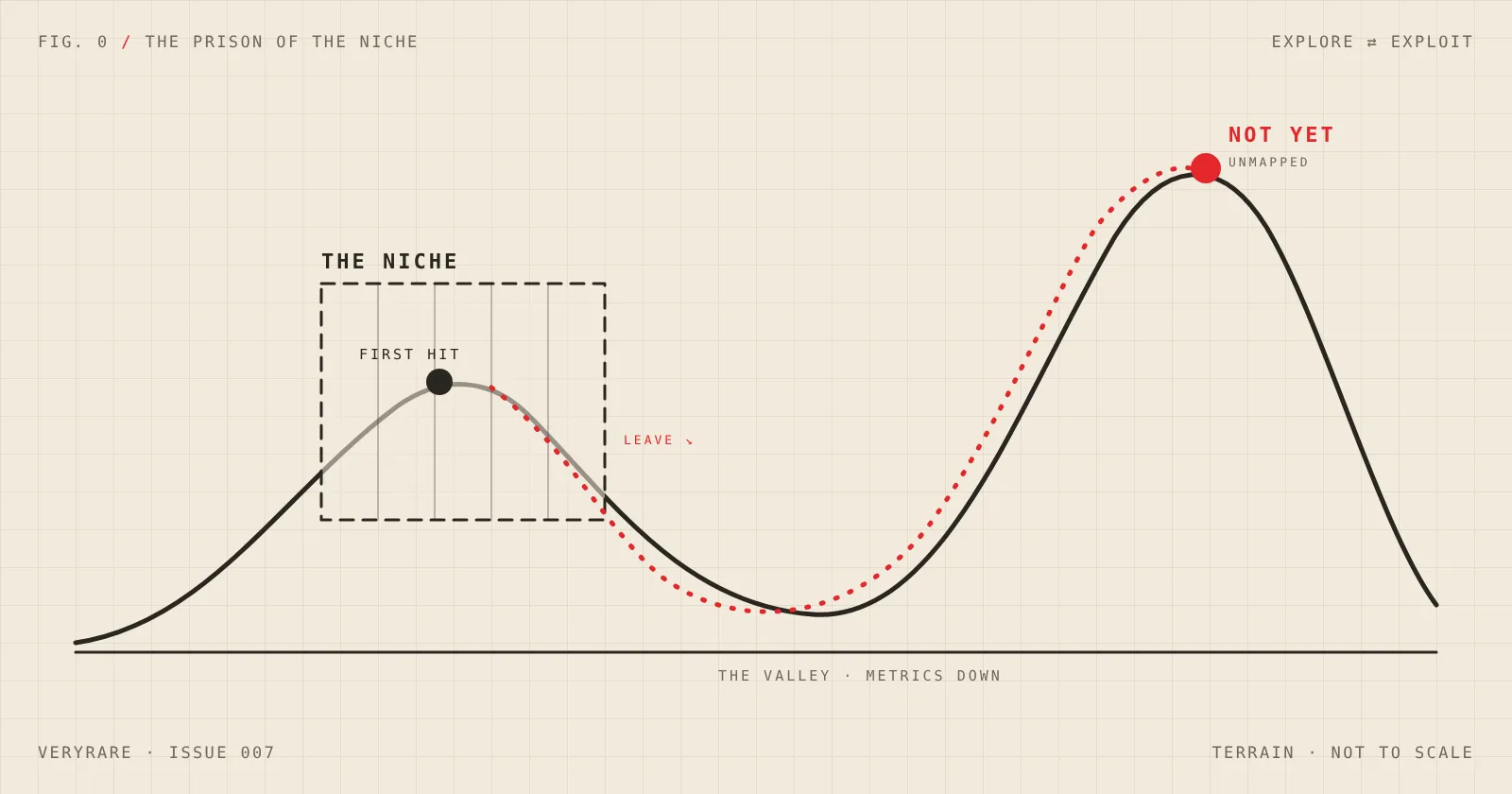
In 1991 the Stanford organizational theorist James G. March gave this a shape. He split learning into exploration, searching for new possibilities, and exploitation, refining what you already know. Both matter. But his models showed that systems tend to get better at exploitation faster than at exploration, which pays off in the short run and turns self-destructive in the long run. The repeatable thing rewards you right away. The unfamiliar thing usually embarrasses you first.
Picture a mountain range. Your first formula is a peak. To reach a different one, maybe a much higher one, you have to walk downhill first, and for a while your work looks worse and people ask why you’re abandoning something that worked. That valley isn’t proof you’re lost. Sometimes it’s the price of finding out how much land there is beyond the hill everyone knows you for.
How much of each season do you spend on the unknown?
Drag the slider. The gray line always repeats the first hit. The red line spends part of every season exploring. Compare the first five seasons with all twenty.
Optimization can make you spectacularly good at something you’ve stopped choosing.
When the audience moves into your head
At first an audience reacts to the work after you make it. Then, almost invisibly, you start inviting it into the room before you make anything. Is it on-brand? Will it hurt reach? You haven’t shown anyone the idea yet, and a thousand imaginary critics have already voted.
Economists have a name for one piece of this. Goodhart’s law, in the anthropologist Marilyn Strathern’s 1997 phrasing: “When a measure becomes a target, it ceases to be a good measure.” Likes were supposed to tell you what landed. Once they become the goal, they stop telling you anything except how to get more likes.
Psychology has another. In 1966 James Marcia described identity foreclosure: committing to an identity without really exploring the alternatives. He was studying students, so take it as an analogy, not a diagnosis. But the shape fits. You make one thing, it succeeds, the world tells you who you are, and you accept the verdict.
And Sartre has the portrait. In Being and Nothingness (1943) he watches a café waiter whose every move is a little too waiter-like, as if he’s playing at being a waiter. Serving coffee is fine. The trouble is believing the role is all you are. Artists do this too: a style becomes a persona, the persona gets polished, and you end up starring in a long-running production about the person you were when the audience first arrived.
Sort the questions in your studio
Each card is a question you might ask before making something. Is it curiosity talking, or the audience you've moved into your head?
Sort all seven.
Kill your Ziggy
The people who escaped tend to do it loudly. On July 3, 1973, at the Hammersmith Odeon in London, David Bowie ended the Ziggy Stardust tour by telling the crowd it was the last show they’d ever do. Fans, papers and even some of his band thought he was quitting music. He was retiring a character that had become a cage, a year and a half into the tour and at the top. The next record, Aladdin Sane, was already in the shops, and D. A. Pennebaker filmed the whole night, so you can still watch the character die on stage.
A century and a half earlier, Hokusai did it with paperwork. He worked under more than thirty names over his career, often switching when his work changed direction. The one he used late in life translates roughly as “the old man mad about painting.” He was in his seventies, and still treating himself like a beginner with a lot left to learn.
Signature ≠ formula
Before this turns into a manifesto against repetition: repetition can be wonderful. Brilliant wrote one kind of thing ten thousand times and it never stopped being his. A painter can spend a lifetime on one mountain and find a new world in its light every morning. Not everyone needs to become a filmmaker, a chef and an architect by Thursday.
The line runs between a formula and a signature. A formula is the surface: the composition, the fabric, the palette, the subject. You can reproduce it from instructions. A signature is the particular way a mind connects things, an obsession with beauty and decay, or myth and modernity, that might take the form of a painting today and a garment tomorrow.
We mistake visual consistency for intellectual consistency because the first one fits in a brand guide. A formula says: I’ll make this again because you recognize it. A signature says: I’ll keep following the questions that made me start. One repeats the result. The other continues the investigation.
Two kinds of consistency
Same maker, four outputs. Flip between the two ways of staying recognizable, then tap a tile.
Be bad at something again
There’s a less glamorous reason people stay put: being good at something feels amazing. Start something new and you lose your competence, your confidence and the comfort of knowing what you’re doing, all at once. The celebrated designer becomes a terrible beginner at film. The ideas are usually there. What goes missing is the patience to sit in the gap between your taste and your ability.
The word amateur comes, through French, from the Latin amator: a lover. Before it meant inexperienced, it meant doing something because you love it. That instinct is the thing to protect. Not every experiment deserves publication, and not every fascination needs a business model. Some of the best things that happen to your imagination look like wasted time on a spreadsheet. Our dashboards count the response. They’re much worse at counting the transformation.
The VERYRARE take: don’t become your own merchandise
I think about this constantly, because I’m on both sides of it. I’m an artist, and I’m building a business, and businesses love repeatability. You find something people respond to, you make it brilliantly, you improve production, and suddenly a whole structure depends on you doing it again.
People know us for artwear: jacquard and tapestry, dense surfaces, references pulled from painting, Japanese prints, cinema, mythology, anime. I love that language and I’m proud of it. I would hate for it to become a dictionary of words we’re never allowed to leave. For a fashion brand the trap is obvious. Your breakthrough fabric becomes your fabric, and the things that made you recognizable start impersonating the reason you existed.
But was the point ever the fabric alone? Or was it one way of making an obsession tangible?
So I don’t want VERYRARE to be a machine that makes more VERYRARE-shaped objects. I want it to be a world that can take other forms when it has something to say in them. This blog is one: a streetwear brand writing long essays with diagrams you can play with, which nobody asked for, and which is exactly why it’s here. The rule is that the medium has to earn its place. Putting a logo on a new category isn’t the same as having something new to say. If we make a film, it should show a side of us that doesn’t fit on a sleeve.
Does the new thing say something a sleeve can't?
Pick a form VERYRARE could take, then answer honestly. The test is the question, not the medium.
Does it say something clothing can't?
That’s why I think a brand’s identity should work less like a moodboard and more like a grammar: a set of instincts that can produce sentences we’ve never said before. Our newsletter wordplay already works that way. CultVRe, sVRprise and futVRe are new words from an old rule. Freedom has real costs. There are budgets, deliveries, people’s livelihoods, and it’s easy to romanticize experiments someone else pays for. Ideally a strong business earns the right to fund risks a weaker one couldn’t. But the order matters. The machine should exist to support the imagination, not the other way around.
I try to hold myself to it too. I’m interested in too many things to let “fashion founder” be the final answer. I want to be a novice again, follow something odd because it fascinates me, find a reference that doesn’t turn straight into a product. Some of that will look incoherent from outside. Some will fail. I’d still rather risk that than spend a lifetime reproducing the conditions of our first applause.
The brand should be recognizable. Its future should not be predetermined.
A niche can be a workshop, a language, a home. The problem isn’t staying. It’s forgetting you’re allowed to leave. So build something people recognize, get exceptional at a craft, let it open doors. Just don’t hand the keys to the audience, the algorithm, or the version of yourself who got lucky first.
They can know what you made yesterday. They don’t get to decide what you make tomorrow.
— [ARTWEAR c/o Raf Reyes]
Notes & further reading
- On Ashleigh Brilliant, his 17-word limit and Brilliant v. W.B. Productions (1979): Wikipedia; NPR, October 2025, on the 10,000 Pot-Shots; his own account of the business.
- Michel Foucault, “What Is an Author?”, lecture to the Société française de philosophie, February 22, 1969; see Progressive Geographies on the text’s history.
- James G. March, “Exploration and Exploitation in Organizational Learning”, Organization Science 2(1), 71 to 87, February 1991.
- Marilyn Strathern, “‘Improving ratings’: audit in the British University system,” European Review, 1997; summarized at Wikipedia: Goodhart’s law.
- James E. Marcia, “Development and validation of ego-identity status,” Journal of Personality and Social Psychology 3(5), 1966.
- Jean-Paul Sartre, Being and Nothingness, 1943; on the waiter, Philosophy Break.
- On the last Ziggy show and Aladdin Sane: American Songwriter setlist.fm, and on Pennebaker’s film, Wikipedia.
- On Hokusai’s names: Sotheby’s and the Smith College Museum of Art.
- On amateur: Etymonline.